The title of this issue is about as exciting as a daily walk down a familiar hallway, until your point of view changes. That point is both literal and figurative.
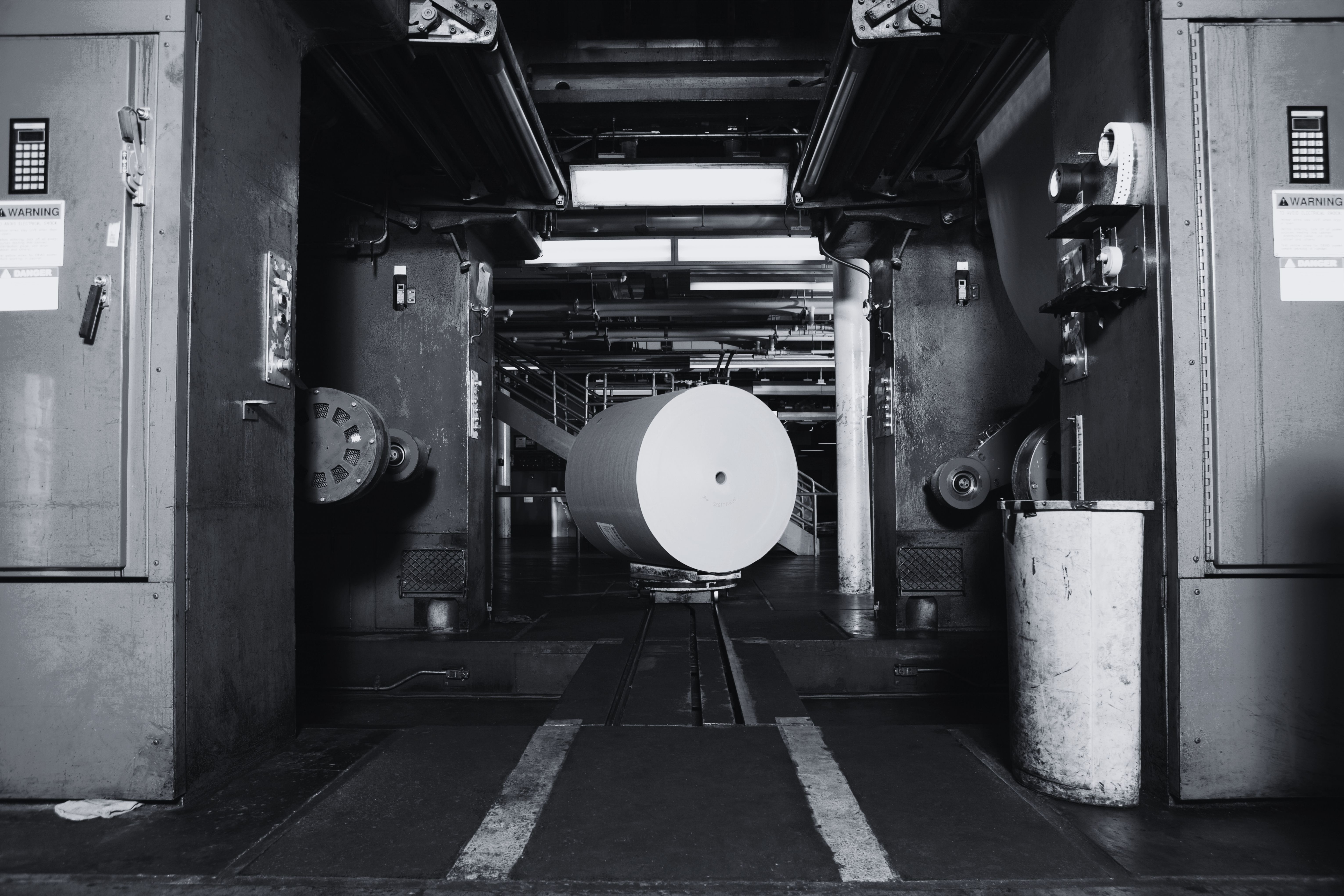
In a newspaper printing plant, there are two tools essential to a paper handler's role: a knife and a ripper. Together, these rudimentary, yet effective tools allow a paper handler to meticulously prepare a 2,000-pound roll of raw paper costing roughly one thousand dollars.
When the roll arrives at the paper handler's station by conveyor belt, there are several steps that must be performed before it is eventually released to a robotic forklift and routed, via automation, to a designated press. The first step involves using a knife to remove the roll's heavy outer protective wrapper, a layer of brown paper similar in texture to cardboard. Over the course of an eight-hour shift, that repeated cutting action across 80 to 120 rolls slowly dulls the knife's edge.
A dull knife is a dangerous knife. The paper handler must exert more pressure on the handle and, by doing so, risks physical injury, damage to the roll's outer edge of fine paper, or both. In addition, the next roll of paper takes longer to prep. Its delayed delivery to the press, which will soon run out of paper, can disrupt the timeliness of the entire newspaper run. A well-trained paper handler periodically sharpens their knife before, during, and after work. An unwitting paper handler amasses a collection of knives. In essence, the worker becomes the workaround.
It is a combination of repetition and inattention that dulls the knife, not the knife's or worker's inherent composition. The latter are merely supportive of the former's proper execution. In enterprise environments, the same pattern appears in systems, workflows, governance, and decisions. Workarounds become the hidden infrastructure that only the people closest to the work know intimately.
When a tool is not maintained, the worker compensates, and when the worker compensates long enough, the workaround becomes indistinguishable from the workflow. Over time, the formal view of the operation begins, subtly and quietly, to diverge from the view held by the boots on the ground. The prepared rolls of paper are still delivered to the presses; however, the compensation required to keep the rolls of paper moving takes on its own form of invisible adjustments, foreign to the established narrative.
A dull knife is not simply a tool in need of sharpening. Sometimes it needs to be sharpened. Sometimes it needs to be replaced. Either way you slice it, it is a literal and metaphorical point that shapes how work is executed. Output, movement, and completion may be misunderstood as operational clarity, but the dull knife reminds us that work, even when repetitive, and the systems that support it require periodic sharpening. It is this refinement that lowers risk, increases output, improves confidence, and provides the systematic feedback vital to a well-oiled enterprise.
The tool may not be le seul problème. Perhaps, it is also your point of view.